

Put Your Tariff Cost on the Invoice. Just Don't Hide It.
November 19, 2026
There are three ways to handle tariffs in Canada:
- Raise every price and hope nobody notices.
- Add a surprise fee and hope nobody notices.
- Show it plainly and let everybody notice.
The first is lazy, the second cost Cineplex $38.9 million, but the third is the business solution.
The Problem: Tariffs in Canada are Back
U.S. tariffs on Canadian products are back like they never left…because they didn’t.
Older U.S. tariffs on steel, aluminum, autos, copper, and lumber have been around since March 13th 2025, and since then, they’ve only added to the list. Now that list includes a 50% tariff on Canadian goods, on everything from Christmas ornaments to floating docks. But Canada isn’t shy about tariffs either. For example, there is an average 218.5% tariff on certain U.S. dairy products, which has been in place long before the trade war began. Mark Carney has answered on par with Trump’s tariffs, implementing counter-tariffs on about $27.6 billion of U.S. goods, and the tariffs on steel, aluminum, clothing, electronics, and other products have gone up to 50%.
It’s hard to tell where this is going, but tariffs move fast, in one day and out the next (at this rate, mostly in), so keep checking back for more information.
If you're a medium-sized Calgary business that depends on importing, you probably noticed costs went up. Now you have to decide what to tell your customers.
Most pick one of two options: raise prices quietly, or add extra fees.
Both are bad. Let’s get into why.
Bad Idea #1: Quietly Raise Every Price to Offset Tariff Cost
Someone got the bright idea that if you spread the tariff over everything, including the products that never went near a border, it'll offset your tariff cost. Easy! The problem is, people are not goldfish, they remember how much things cost now vs. then. By trying to pull a sneaky one, you look like the bad guy, which customers remember too.
Secondly, you just made your competitor, who raised only what they had to, look honest and worthy of YOUR customer's attention. Whoopsies!
Bad Idea #2: Surprise Your Customers With an Extra Fee
Because who doesn't love extra fees?!
This way, you can keep the sticker price low, then add a "tariff surcharge" at the very end. Customers love finding a new line at the bottom of a bill. It's like finding a parking ticket under your windshield wiper.
The Canadian Catch: Drip Pricing
Drip pricing means advertising one price, then adding mandatory fees so that price can't actually be had. Under the Competition Act, that’s a problem unless the charge is a fixed one the government puts on the buyer, like sales tax. The Competition Bureau suggests asking yourself a simple question: will customers be surprised by this extra fee?
A tariff is a government charge, but it is paid by the importer, not the customer. So don't count on the sales tax exception to save you. Check that one with a lawyer.
Cineplex found out the hard way when it added a mandatory $1.50 online booking fee. In 2024, the Competition Tribunal found that was drip pricing and ordered a $38.9 million penalty, the same as every booking fee Cineplex collected from June 2022 to December 2023. The Tribunal could have gone as high as three times that. Cineplex appealed and lost in January 2026.
All for a fee smaller than a bad cup of coffee.
The stakes are not shrinking. The maximum civil penalty is now the greater of either $10 million or three times the benefit you got, and since June 2025, private parties can ask the Tribunal for permission to bring forward their own claims.
The Fix: The Right Way to Offset Tariff Costs in Canada
Here is the honest way to do it, in five steps:
- Work out what the tariff actually costs you, per product or job, no padding: The Bureau also says a charge that varies can still raise concerns, so keep the number tied to real costs.
- Put the tariff cost in the price you quote and advertise: The price on your website, your quote, and your sign. No surprises at the end.
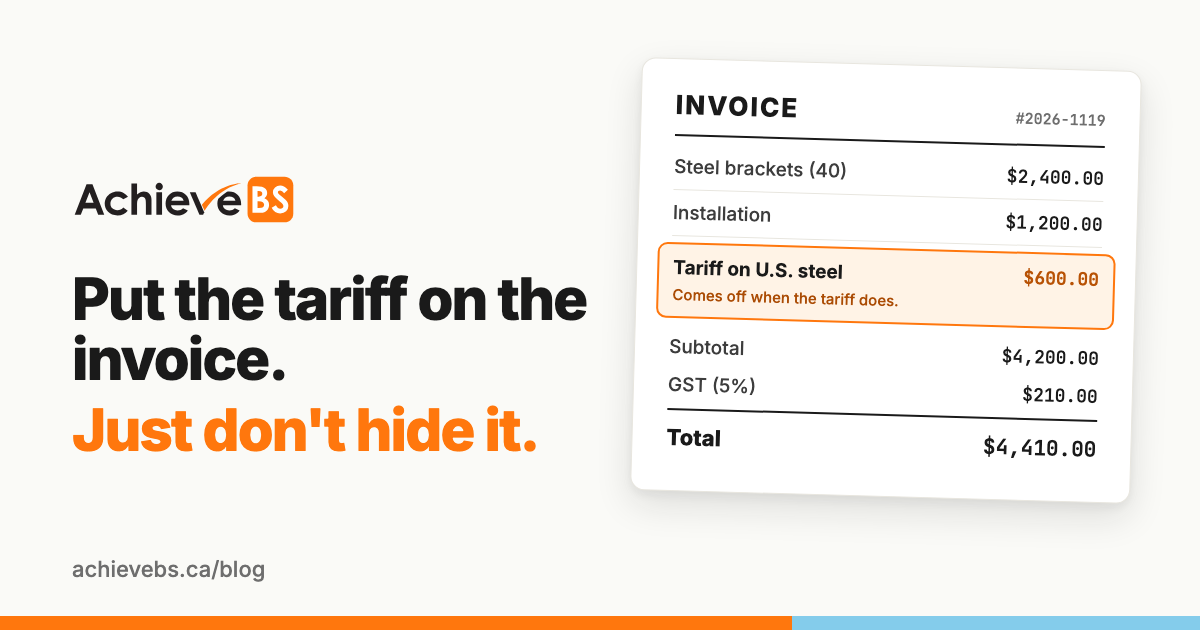
- On the invoice, show it as its own line with one plain sentence. Something like: "This covers the tariff on [item]. It comes off when the tariff does." Customers see why the price went up, and you look like the grown-up in the room. Achieve has been saying since 2017 that invoices get opened and read, so you might as well make this one worth reading.
- Charge GST/HST on the full amount. The CRA has said that duties and fees tied to bringing a product in count as part of the price for GST/HST. But double-check this one with your accountant.
- When the tariff changes, change the line and tell your customers. When the tariff drops, the line drops with it, and you get to send the best email of the year: “Good news, the tariff is gone and so is the charge!”
You didn't pick the tariff, but don't pick the hard way to tell your customers. By being upfront and transparent, you can offset your tariff costs and nobody gets hurt, offended, or fined. It’s the closest we can get to a win-win given the circumstances.
Want to find the other bottlenecks in your business that are losing you time and money? Take Achieve's Hidden Hours Audit and get a free report with your biggest leaks and quick wins (hidden surcharge not included).
This is general information, not legal or tax advice. Talk to your lawyer and accountant before you change how you price or invoice.
One useful email a month
The fixes we use with clients, what's real in AI, and nothing else. No BS.
Find out where the hours are going.
The Hidden Hours Audit. Free. Twelve minutes of your time, a written report in five business days. Nine out of ten people who took it said it was useful.